
Define a decision that can be checked
Specify what the inspection should establish: whether a feature is present, a code is readable, a part is positioned correctly or a defined defect exists. Describe acceptable variation and who decides the correct classification of a borderline sample.
Write the result in production terms: accepted, rejected or sent for additional review. This gives quality and engineering teams a shared starting point.
Collect representative samples
Include normal product variants, known defects and examples close to the acceptance boundary. Record the expected classification and relevant differences between batches. A small set of ideal parts leaves important conditions untested.
If a method learns from images, keep evaluation images separate from the images used to train it. Cognex’s documentation explains that the test set should represent expected operating variation and should not be part of training.
Make the relevant feature visible
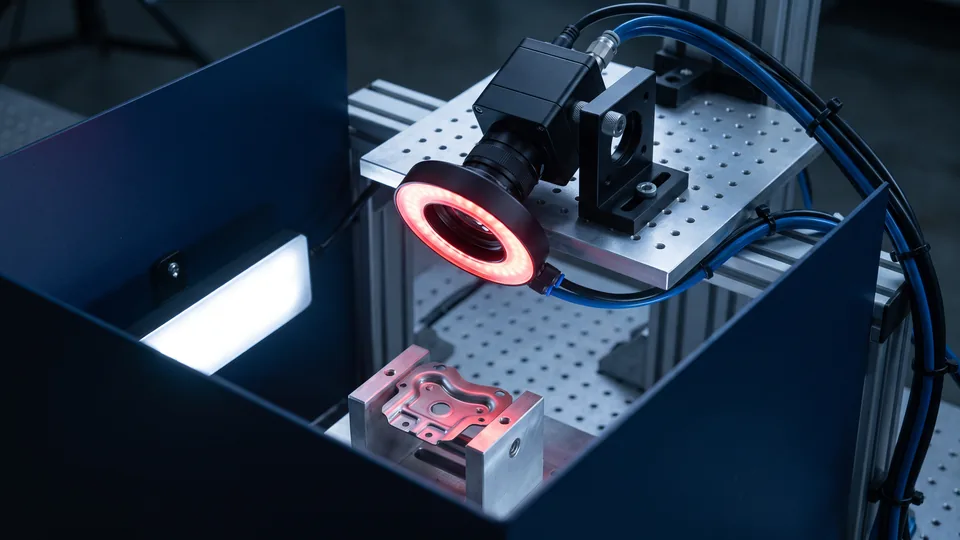
Describe product position, available viewing space, surface appearance, motion and ambient light. These conditions influence the image that can be acquired and the time available for inspection.
Cognex’s acquisition guidance identifies field of view, working distance, optics and lighting as central setup decisions. Assess the image before assuming that an algorithm or a higher camera resolution will resolve the inspection problem.
Count the errors that matter
A missed defect and a wrongly rejected good part are different outcomes. Report them separately, with the sample quantities, product mix and test conditions. One overall accuracy percentage can hide the error that matters most to the process.
Cognex distinguishes incorrect detection from failure to detect a real feature or defect. A result from a limited test is evidence for those test conditions; wider production coverage needs its own validation.
Connect the result to the right product
Define when the image is triggered, how the result identifies the inspected item and which machine receives it. Agree the response to rejection, no result or an unavailable downstream station. Inspection has to fit the product flow as well as the image.
A useful first discussion with Axistra includes the inspection objective, classified samples and the required response. Bring us your production challenge.
Sources and further reading
- Cognex — Testing Image Sample Set
- Cognex — Acquire Images
- Cognex — Positive, Negative, and False Results
- Cognex — Getting Started: In-Sight Vision System Machine Vision Solution
References describe particular technologies and approaches. They do not establish Axistra certification or partner status.